Planning Ahead for Container Collections and Deliveries
Through our Customer Journey programme and ongoing engagement with customers across the supply chain, we've consistently heard that delays in cargo readiness and the late transfer of documentation can create unnecessary challenges when planning container collections and deliveries. A key theme from this feedback is the importance of ensuring all cargo requirements are completed as early as possible so transport providers have sufficient time to plan, secure Vehicle Booking System (VBS) slots, and move cargo efficiently through the Port.
To support the smooth and timely movement of cargo, we encourage all parties in the supply chain to ensure the following are completed well in advance:
- MPI clearances and inspections
- Customs clearances
- Shipping line releases
- Any outstanding holds or regulatory requirements
- Timely transfer of documentation and release information to your transport provider
Providing transport partners with release-ready cargo information as early as possible enables them to better plan their operations, book VBS slots ahead of time, and coordinate resources efficiently. This helps reduce last-minute booking pressures, minimises avoidable delays, and supports more predictable collection and delivery timeframes. Feedback gathered through our Customer Journey work has highlighted that late clearances or delays in providing documentation can significantly reduce available booking options and create operational challenges for transport operators, ultimately impacting cargo movement across the wider supply chain. By working together and ensuring cargo is release-ready before collection is required, we can improve planning certainty, support efficient Port operations, and help reduce unnecessary delays for everyone involved in moving cargo through Auckland.
🏗 FergussonTerminal Update
Thank you for your patience and cooperation during the fog-related disruptions over the past two weeks. The temporary stoppages were necessary to ensure safe operations, and we appreciate the support of our customers and transport partners as we returned to normal operating conditions.
Average on time arrivals for the past 4 weeks was 78% with average on time departure for those that arrived on window at 56% for the same period.
🚚 Multi-Cargo (MC) Operations
Container/Bulk berths and yard is at 30% capacity and expected to increase to full capacity from this weekend with both discharges & receivals.
PCC Car volume in the yard is currently at 30% capacity and expected to increase to full capacity for next two weeks.
Bledisloe North wharf & the Car Handling Facility construction on track for completion end Q1, 2027.
Next week is expected to be very busy with both conventional & RORO vessels.
If you are on port, please follow the instructions of the MC Ops & Stevedoring team. Check with supervisors before entering operational areas. Safety First!
⚠Safety Notice:
To ensure your safety and visibility in operational areas, all clothing must meet the following standards:
Compliant PPE Worn on any Port of Auckland (POAL) Premises:
Hi-Vis Clothing
To ensure your safety and visibility in operational areas, all clothing must meet the following standards:
AS/NZS 4602.1:2011 - Class "D/N" - AS/NZS 1906.4:2010 - Hi Visibility Materials for Safety Garments.
Clothing must fit properly, be free or rips and tear, be clean and have day and night strips for visibility.
Acceptable safety clothing includes high-visibility fabrics and retroreflective materials that provide a strong optical effect in response to natura or generated light.
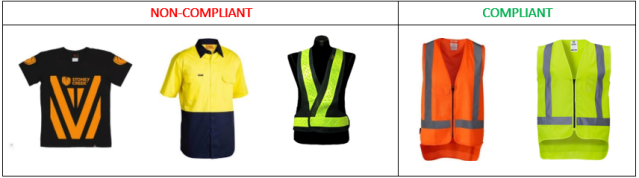
Examples of non-compliant and compliant Hi-Vis garments have been provided below:
PPE Footwear
POAL also requires all staff, contractors and visitors entering an operational site to wear footwear compliant with AS/NZ 2210.3:2009 standard. This ensures that footwear provides the adequate protection from workplace hazards. Safety footwear should include a protective toe cap made of steel or composite, slip resistant soles, puncture resistant materials and adequate support for the foot and ankle. Therefore, sports shoes and sneakers are not adequate footwear for personnel to wear while in an operational area.
Tariffs
Demurrage and Storage
Service Type
Service Provided
Port
Location
Charge
Price Change
Containers
Export Storage Full Containers: Over 7 calendar days prior to vessel ETA
Auckland
Terminal
$82.00 per TEU / day
$86.00 effective
For containers delivered Exceeding the Allowable Dwell Time:1) Storage will be charged from delivery date until the start of the free period which comprises 7 days prior to the expected date of arrival (ETA) of the vessel at gate in. 2) Where containers do not load to the nominated vessel, export storage will apply to all calendar days above 7 days from receival at Fergusson Terminal.
Containers
Export Storage Empty Containers: Over 7 calendar days prior to vessel ETA
Auckland
Terminal
$55.00 per TEU / day
$58.00 effective
For containers delivered Exceeding the Allowable Dwell Time: 1) Storage will be charged from delivery date until the start of the free period which comprises 7 days prior to the expected date of arrival (ETA) of the vessel at gate in. 2) Where containers do not load to the nominated vessel, export storage will apply to all calendar days above 7 days from receival at Fergusson Terminal.
Containers
Export Storage: Over 5 calendar days prior to vessel actual commence load date
Auckland
Multi-Cargo
$82.00 per TEU / day
$86.00 effective
For containers delivered early the following rule applies: 1) Storage will be charged from delivery date until the start of the free period which comprises 5 days prior to the date load operations commence. 2) If load operations commence after 15:00 hours, the 5 days will include the day of load operations. 3) The 5 free days include Sundays. 4) Where containers do not load to the nominated vessel, export storage will apply to all calendar days above 5 days at Multi Cargo.
Containers
Import Demurrage 4-7 days Full Containers
Auckland
Terminal, Multi-Cargo
$149.00 per TEU / day
$157.00 effective
For containers remaining beyond their free time the following rules apply: 1) Storage will be charged from the end of the free days to date of delivery. 2) Free time is extended to 0600 hours after the designated free days. 3) All associated reefer charges are applicable once on demurrage. 4) The free days include weekends and exclude Public Holidays. (Once on demurrage all days are chargeable). 5)This rate will also apply to Import containers returned to the port after delivery, from the day of return at the applicable tiered rate.
Containers
Import Demurrage 4-7 days Empty Containers
Auckland
Terminal, Multi-Cargo
$110.00 per TEU / day
$116.00 effective
For containers remaining beyond their free time the following rules apply: 1) Storage will be charged from the end of the free days to date of delivery. 2) Free time is extended to 0600 hours after the designated free days. 3) All associated reefer charges are applicable once on demurrage. 4) The free days include weekends and exclude Public Holidays. (Once on demurrage all days are chargeable). 5) This rate will also apply to Import containers returned to the port after delivery, from the day of return at the applicable tiered rate.
Containers
Import Demurrage 8-14 days Full Containers
Auckland
Terminal, Multi-Cargo
$262.00 per TEU / day
$275.00 effective
For containers remaining beyond their free time the following rules apply: 1) Storage will be charged from the end of the free days to date of delivery. 2) Free time is extended to 0600 hours after the designated free days. 3) All associated reefer charges are applicable once on demurrage. 4) The free days include weekends and exclude Public Holidays. (Once on demurrage all days are chargeable). 5) This rate will also apply to Import containers returned to the port after delivery, from the day of return at the applicable tiered rate.
Containers
Import Demurrage 8-14 days Empty Containers
Auckland
Terminal, Multi-Cargo
$160.00 per TEU / day
$168.00 effective
For containers remaining beyond their free time the following rules apply: 1) Storage will be charged from the end of the free days to date of delivery. 2) Free time is extended to 0600 hours after the designated free days. 3) All associated reefer charges are applicable once on demurrage. 4) The free days include weekends and exclude Public Holidays. (Once on demurrage all days are chargeable). 5) This rate will also apply to Import containers returned to the port after delivery, from the day of return at the applicable tiered rate.
Containers
Import Demurrage 15+ days Full Containers
Auckland
Terminal, Multi-Cargo
$354.00 per TEU / day
$372.00 effective
For containers remaining beyond their free time the following rules apply: 1) Storage will be charged from the end of the free days to date of delivery. 2) Free time is extended to 0600 hours after the designated free days. 3) All associated reefer charges are applicable once on demurrage. 4) The free days include weekends and exclude Public Holidays. (Once on demurrage all days are chargeable). 5) This rate will also apply to Import containers returned to the port after delivery, from the day of return at the applicable tiered rate.
Containers
Import Demurrage 15+ days Empty Containers
Auckland
Terminal, Multi-Cargo
$205.00 per TEU / day
$215.00 effective
For containers remaining beyond their free time the following rules apply: 1) Storage will be charged from the end of the free days to date of delivery. 2) Free time is extended to 0600 hours after the designated free days. 3) All associated reefer charges are applicable once on demurrage. 4) The free days include weekends and exclude Public Holidays. (Once on demurrage all days are chargeable). 5) This rate will also apply to Import containers returned to the port after delivery, from the day of return at the applicable tiered rate.
Containers
Storage Transhipment Containers
Auckland
Terminal, Multi-Cargo
$56.00 per TEU / day
$59.00 effective
First 10 calendar days from discharge ex vessel up to and including day of load on outbound vessel from POAL are free of charge. Thereafter storage charge applies to the outbound line operator. Tranship is defined as: Containers that arrive and leave in the same condition within POAL from one wharf to another.
Containers
Storage of Dangerous Goods - Import/Export 20'
Auckland
Terminal, Multi-Cargo
$286.00 per Cont / day
$301.00 effective
Charged per day beyond approved DG dwell time on Port. All moves additional. Classes 6 & 8 are excluded as our DG approval prohibits POAL from storing these class beyond their approved dwell time on port. Export charges are billed to the outbound line operator.
Containers
Storage of Dangerous Goods - Import/Export 40'
Auckland
Terminal, Multi-Cargo
$379.00 per Cont / day
$398.00 effective
Charged per day beyond approved DG dwell time on Port. All moves additional. Classes 6 & 8 are excluded as our DG approval prohibits POAL from storing these class beyond their approved dwell time on port. Export charges are billed to the outbound line operator.
Containers
Storage of Dangerous Goods - Tranship
Auckland
Terminal, Multi-Cargo
$126.00 per TEU / day
$132.00 effective
Charged per day beyond approved DG dwell time on Port. All moves additional. Classes 6 & 8 are prohibited from being stored beyond their approved dwell time on port. Charge applies to the outbound line operator.
For breakbulk remaining beyond the free time the following rules apply: 1) Storage will be charged from the end of the 4 free days to date of delivery. 2) Free time is extended to 0600 hours after the designated free days. 3) The 4 free days include weekends and exclude Public Holidays. Charge is per tonne or m3, per day, whichever is greater.
General Cargo
Export Storage Breakbulk: Over 5 calendar days prior to vessel actual commence load date
Auckland
Multi-Cargo
$10.10 per tonne / m3 / day
$10.62 effective
For breakbulk delivered early the following rule applies: 1) Storage will be charged from delivery date until the start of the free period which comprises 5 days prior to the date load operations commence. 2) If load operations commence after 15:00 hours, the 5 days will include the day of load operations. 3) The 5 free days include Sundays". Charge is per tonne or m3, per day, whichever is greater.
General Cargo
Storage Transhipment breakbulk/LCL
Auckland
Terminal, Multi-Cargo
$3.90 per tonne / m3 / day
$4.10 effective
First 10 calendar days from discharge are free of charge. Thereafter storage charge applies. This charge is payable by the outbound carrier unless prior arrangement has been made with the shipper or an alternative party prior to discharge. Charge is per tonne or m3, per day, whichever is greater.
Vehicles
Import Demurrage Vehicles up to 20m3 5-7 days
Auckland
Multi-Cargo
$128.00 per Unit / day
$135.00 effective
For vehicles picked up after the free period the following rules apply: 1) Demurrage will be charged at the end of the free period which comprises of 4 free days including weekends but excluding public holidays. (Once on demurrage all days are chargeable). 2) Free time is extended to 0600 hours after the designated free days.
Vehicles
Import Demurrage Vehicles up to 20m3 8-14 days
Auckland
Multi-Cargo
$197.00 per Unit / day
$207.00 effective
For vehicles picked up after the free period the following rules apply: 1) Demurrage will be charged at the end of the free period which comprises of 4 free days including weekends but excluding public holidays. (Once on demurrage all days are chargeable). 2) Free time is extended to 0600 hours after the designated free days.
Vehicles
Import Demurrage Vehicles up to 20m3 15 days and over
Auckland
Multi-Cargo
$324.00 per Unit / day
$341.00 effective
For vehicles picked up after the free period the following rules apply: 1) Demurrage will be charged at the end of the free period which comprises of 4 free days including weekends but excluding public holidays. (Once on demurrage all days are chargeable). 2) Free time is extended to 0600 hours after the designated free days.
Vehicles
Export Storage Vehicles up to 20m3: Over 5 calendar days prior to vessel actual commence load date
Auckland
Multi-Cargo
$128.00 per Unit / day
$135.00 effective
For Vehicles delivered early the following rule apply: 1) Storage will be charged from the delivery date until the start of the free period which comprises 5 days prior to the date load operations commence. 2) If the load operations commence after 15:00 hours, the 5 days will include the day of load operations. 3) The 5 free days includes Sunday. 4) Vehicles over 20m3 - Export Storage Breakbulk charge applies.
Vehicles
Storage Transhipment vehicles up to 20m3. 11-15 days
Auckland
Multi-Cargo
$21.00 per Unit / day
$22.00 effective
First 10 calendar days from discharge are free of charge. This charge is payable by the outbound carrier unless prior arrangement has been made with the shipper or an alternative party prior to discharge.
Vehicles
Storage Transhipment vehicles up to 20m3. 16-23 days
Auckland
Multi-Cargo
$32.00 per Unit / day
$34.00 effective
First 10 calendar days from discharge are free of charge. This charge is payable by the outbound carrier unless prior arrangement has been made with the shipper or an alternative party prior to discharge.
Vehicles
Storage Transhipment vehicles up to 20m3. 24 days and over
Auckland
Multi-Cargo
$54.00 per Unit / day
$57.00 effective
First 10 calendar days from discharge are free of charge. This charge is payable by the outbound carrier unless prior arrangement has been made with the shipper or an alternative party prior to discharge.
Empty Container Service
Service Type
Service Provided
Port
Location
Charge
Price Change
Receipt and Delivery
Link Facility Empty Road Deliver 20'
Auckland
Terminal
$48.00 per Cont
-
Delivery from Link to Road
Receipt and Delivery
Link Facility Empty Road Deliver 40'
Auckland
Terminal
$55.00 per Cont
-
Delivery from Link to Road
Link
Link Facility Empty Road/Vessel Receive 20'
Auckland
Terminal
$99.00 per Cont
-
Receival into Link; 7 days storage; delivery to Terminal
Link
Link Facility Empty Road/Vessel Receive 40'
Auckland
Terminal
$152.00 per Cont
-
Receival into Link; 7 days storage; delivery to Terminal
Link
Link Facility Empty Rail Receive/Deliver 20' - charged per event
Auckland
Terminal
$152.00 per Cont
-
Receival into Link; 7 days storage; delivery to Terminal
Link
Link Facility Empty Rail Receive/Deliver 40' - charged per event
Auckland
Terminal
$218.00 per Cont
-
Receival into Link; 7 days storage; delivery to Terminal
Storage
Daily storage of Containers Empty 20'
Auckland
Terminal
$16.00 per Cont / day
-
Link Facility Daily storage of container
Storage
Daily storage of Containers Empty 40'
Auckland
Terminal
$30.00 per Cont / day
-
Link Facility Daily storage of container
FAF
Service Type
Service Provided
Port
Location
Charge
Price Change
Misc
Fuel Adjustment Factor - vessels 10,000 GRT and under
Auckland
Terminal, Multi-Cargo
$380.00 per Visit
$460.00 effective
The calculation used to determine FAF is based on current pricing, working in bands of +/-20%. If the six week average triggers a move up or down, this will occur with four weeks notice of the change. Currently it is in the +101% to +120% band. Effective 6th November 2026 it will move into the +121% to +140% band. See latest notifications here. The FAF tier applicable on the date of vessel arrival will be applied.
Misc
Fuel Adjustment Factor - vessels over 10,000 GRT
Auckland
Terminal, Multi-Cargo
$540.00 per Visit
$620.00 effective
The calculation used to determine FAF is based on current pricing, working in bands of +/-20%. If the six week average triggers a move up or down, this will occur with four weeks notice of the change. Currently it is in the +101% to +120% band. Effective 6th November 2026 it will move into the +121% to +140% band. See latest notifications here. The FAF tier applicable on the date of vessel arrival will be applied.
Misc
Fuel Adjustment Factor - Full Import/Export
Auckland
Terminal
$17.50 per Cont
$20.00 effective
The calculation used to determine FAF is based on current pricing, working in bands of +/-20%. If the six week average triggers a move up or down, this will occur with four weeks notice of the change. Currently it is in the +101% to +120% band. Effective 6th November 2026 it will move into the +121% to +140% band. See latest notifications here. The FAF tier applicable on the date of vessel arrival will be applied.
Misc
Fuel Adjustment Factor - Full Transhipment per leg
Auckland
Terminal
$8.75 per Cont
$10.00 effective
The calculation used to determine FAF is based on current pricing, working in bands of +/-20%. If the six week average triggers a move up or down, this will occur with four weeks notice of the change. Currently it is in the +101% to +120% band. Effective 6th November 2026 it will move into the +121% to +140% band. See latest notifications here. The FAF tier applicable on the date of vessel arrival will be applied.
Interwharf Transport
Service Type
Service Provided
Port
Location
Charge
Price Change
Containers
Transfer Normal Delivery Full 20'
Auckland
Terminal, Multi-Cargo
$102.00 per Cont
$107.00 effective
Containers preadvised 36 hrs prior to arrival of departing vessel during normal Customer Service hours and available on port 24 hrs prior to arrival of departing vessel, will incur normal delivery charges. The move will be guaranteed. Excludes transfer of OOG containers which will be charged as listed below. Customer Service hours can be found on the POA website on the Customer Services page.
Containers
Transfer Normal Delivery Full 40'
Auckland
Terminal, Multi-Cargo
$173.00 per Cont
$182.00 effective
Containers preadvised 36 hrs prior to arrival of departing vessel during normal Customer Service hours and available on port 24 hrs prior to arrival of departing vessel, will incur normal delivery charges. The move will be guaranteed. Excludes transfer of OOG containers which will be charged as listed below. Customer Service hours can be found on the POA website on the Customer Services page.
Containers
Transfer Normal Delivery Empty 20'
Auckland
Terminal, Multi-Cargo
$75.00 per Cont
$79.00 effective
Containers preadvised 36 hrs prior to arrival of departing vessel during normal Customer Service hours and available on port 24 hrs prior to arrival of departing vessel, will incur normal delivery charges. The move will be guaranteed. Excludes transfer of OOG containers which will be charged as listed below. Customer Service hours can be found on the POA website on the Customer Services page.
Containers
Transfer Normal Delivery Empty 40'
Auckland
Terminal, Multi-Cargo
$148.00 per Cont
$156.00 effective
Containers preadvised 36 hrs prior to arrival of departing vessel during normal Customer Service hours and available on port 24 hrs prior to arrival of departing vessel, will incur normal delivery charges. The move will be guaranteed. Excludes transfer of OOG containers which will be charged as listed below. Customer Service hours can be found on the POA website on the Customer Services page.
Containers
Transfer Urgent Delivery Full 20'
Auckland
Terminal, Multi-Cargo
$196.00 per Cont
$206.00 effective
Containers not meeting the conditions for normal delivery will incur urgent delivery charges and be moved on a 'Best Endeavours' basis. Excludes transfer of OOG containers which will be charged as listed below.
Containers
Transfer Urgent Delivery Full 40'
Auckland
Terminal, Multi-Cargo
$337.00 per Cont
$354.00 effective
Containers not meeting the conditions for normal delivery will incur urgent delivery charges and be moved on a 'Best Endeavours' basis. Excludes transfer of OOG containers which will be charged as listed below.
Containers
Transfer Urgent Delivery Empty 20'
Auckland
Terminal, Multi-Cargo
$150.00 per Cont
$158.00 effective
Containers not meeting the conditions for normal delivery will incur urgent delivery charges and be moved on a 'Best Endeavours' basis. Excludes transfer of OOG containers which will be charged as listed below.
Containers
Transfer Urgent Delivery Empty 40'
Auckland
Terminal, Multi-Cargo
$285.00 per Cont
$300.00 effective
Containers not meeting the conditions for normal delivery will incur urgent delivery charges and be moved on a 'Best Endeavours' basis. Excludes transfer of OOG containers which will be charged as listed below.
Containers
Sunday shuttle rates
Auckland
Terminal, Multi-Cargo
-
By arrangement. Notification required by 1500 previous Friday.
Containers
Transfer Standard OOG Container
Auckland
Terminal, Multi-Cargo
$360.00 per Cont
$380.00 effective
Limits: over-height;<1.85m; over-width; <0.35m either side; over-length <0.5m either side; max weight <40.0tns. OOG containers outside of these parameters will be charged as Non-Standard/Excess OOG. If corner castings not clear - price on application.
Containers
Transfer Non-Standard /Excess OOG Container
Auckland
Terminal, Multi-Cargo
$1073.00 per Cont
$1130.00 effective
Dimensions outside the parameters listed above for Standard OOG Container. If corner castings not clear - price on application.
Marine Charges
Service Type
Service Provided
Port
Location
Charge
Price Change
Marine Service
Marine Service Charge
Auckland
Terminal, Multi-Cargo
$1.97 per GRT
-
Including pilotage, towage and linesmen both inwards and outwards, plus port dues for Auckland. Minimum charge applies $6,798.00. This will increase to $7,145.00 on 1st January 2027.
Marine Service
Vessel move between berths
Auckland
Terminal, Multi-Cargo
$1.10 per GRT
$1.16 effective
Minimum charge applies $5,808.00. This will increase to $6,104.00 on 1st January 2027. Not applicable to Dead ship move.
Marine Service
Tug Hire per Hour
Auckland
Terminal, Multi-Cargo
$4246.00 per Hour
$4463.00 effective
Additional to allocation under MSC (applicable to all customers).
Marine Service
Additional Lines Person
Auckland
Terminal, Multi-Cargo
$320.00 per Person
$336.00 effective
Per linesperson/per 4hr minimum (applicable to all customers).
Marine Service
Dead Ship Movement
Auckland
Terminal, Multi-Cargo
$1.58 per GRT
$1.66 effective
Charged for moving a vessel that has experienced engine failure or similar. Minimum charge of $6,222.00 applies. This will increase to $6,539.00 on 1st January 2027.
Berthage
Berth hire (Working Cargo)
Auckland
Terminal, Multi-Cargo
$0.17 per GRT / 24 hrs
$0.18 effective
Minimum charge applies $355.00. This will increase to $373.00 on 1st January 2027.
Berthage
Lay-by berthage (Non-Working Cargo)
Auckland
Terminal, Multi-Cargo
$0.55 per GRT / 24 hrs
$0.58 effective
Applied to a vessel that stops cargo operations (excl. weather related stoppage) or considered to be a non-working cargo vessel, under repair and/or detained. The first 24hrs is charged at the full rate and thereafter will be charged in 12hr blocks. Minimum charge applies $536.00. This will increase to $563.00 on 1st January 2027.
Berthage
Small Commercial & Fishing Vessels Up to 20 metres - LOA
Auckland
Terminal, Multi-Cargo
$221.00 per Day
$232.00 effective
Berthage is applied on a per day basis (working or non-working cargo).
Berthage
Small Commercial & Fishing Vessels 20-40 metres - LOA
Auckland
Terminal, Multi-Cargo
$286.00 per Day
$301.00 effective
Berthage is applied on a per day basis (working or non-working cargo)
Berthage
Small Commercial & Fishing Vessels Greater than 40 metres - LOA
Auckland
Terminal, Multi-Cargo
$0.21 per GRT / 24 hrs
$0.22 effective
Berthage (working) is applied on a per day basis. Berthage (non-working) is applied in 12hr blocks, after the first 24hr period.Minimum charge applies $335.00. This wil increase to $352.00 on 1st January 2027.
Misc
Pilot Boat Hire - with shipping movements
Auckland
Terminal, Multi-Cargo
$740.00 per Hour
$778.00 effective
If used in conjunction with shipping movements.
Misc
Pilot Boat Hire
Auckland
Terminal, Multi-Cargo
$991.00 per Hour
$1042.00 effective
For a specific callout not in conjunction with shipping movements.
Misc
Provision of Water (excludes waste water return)
Auckland
Terminal, Multi-Cargo
$6.30 per 1000 lts
$6.60 effective
For use of water, including water for dust suppression. Minimum charge $171.00 applies if POAL issued standpipe is not used. This will increase to $180.00 on 1st January 2027. Minimum does not apply when a valid POAL 'Standpipe Hydrant Permit Fee' of $1,200.00 p.a. is issued.
Misc
Garbage Collection
Auckland
Terminal, Multi-Cargo
$133.00 per Drum
$140.00 effective
For miscellaneous items for collection, the price will be quoted on application. A call out fee of $228.00 is applicable between 1500 and 0700 - 7 days. This will increase to $240.00 on 1st January 2027.
Misc
Brow Gangway - per day
Auckland
Terminal, Multi-Cargo
$774.00 per Day
$813.00 effective
Includes set up and connection. Minimum 1 Day charge is applicable.
Misc
Floating Fenders (each)/ per day
Auckland
Terminal, Multi-Cargo
$254.00 per Unit / day
$267.00 effective
Fender/Tyre log
Miscellaneous Charges
Service Type
Service Provided
Port
Location
Charge
Price Change
Misc
Change of status and details once delivered to the port
Auckland
Terminal, Multi-Cargo
$38.00 per Unit
$40.00 effective
Charge for ANY Manual/EDI change to ANY cargo details e.g : 1) Vessel/voyage; 2) Routing; 3) ISO (Equipment); 4) Commodity; 5) Temperature; 6) Hazardous Information; 7) Booking Information; 8) LOP; 9) Weight (VGM); 10) VIN number; 11) Imports nominated for rail after Vessel ETA. Any applicable moves MAY be charged in addition to this.
Containers
Fumigation - Terminals
Auckland
Terminal
$356.00 per Cont
$375.00 effective
Includes use of area plus move to/from facility. Standard free storage applies.
Services
Fumigation - Multi Cargo
Auckland
Multi-Cargo
$96.00 per Unit
$101.00 effective
Includes use of area - containers, vehicles or unitised cargo. Timber Packs charged per pack up to 20m3. Standard free storage applies
Services
Heat Treatment
Auckland
Multi-Cargo
$60.00 per Unit/TEU
$63.00 effective
Includes use of area - containers, vehicles or unitised cargo. Timber Packs charged per pack up to 20m3.
Containers
Customs Internal Inspection Containers
Auckland
Terminal, Multi-Cargo
$381.00 per Cont
$400.00 effective
Includes moves to/from inspection facility.
Containers
Internal move within a terminal 20'
Auckland
Terminal
$103.00 per 20'
$108.00 effective
Additional move of a container within the same wharf.
Containers
Internal move within a terminal 40'
Auckland
Terminal
$175.00 per 40'
$184.00 effective
Additional move of a container within the same wharf.
Containers
MPI 6 sided External Inspection - Terminals
Auckland
Terminal
$373.00 per Cont
$392.00 effective
Includes use of area, plus move to/from facility
Containers
MPI 6 sided External Inspection - Multi-Cargo
Auckland
Multi-Cargo
$10.00 per Cont
$10.50 effective
Facility fee for use of area for 6 sided inspection. Charged with the Ship Exchange invoice
Containers
MPI Internal Inspection 20'
Auckland
Terminal, Multi-Cargo
$512.00 per 20'
$538.00 effective
Includes use of area and facility, plus moves to/from facility
Containers
MPI Internal Inspection 40'
Auckland
Terminal, Multi-Cargo
$733.00 per 40'
$770.00 effective
Includes use of area and facility, plus moves to/from facility
Containers
Reinstate Container - Late CEDO
Auckland
Terminal
$416.00 per Cont
$435.00 effective
Reinstate container to the vessel load list if the CEDO is received late and operationally can be planned to the vessel. Applied to any container that doesn't have a valid CEDO within 24 hours prior to the vessels ETA.
Containers
Containers Vanned/Devanned Import/Export 20'
Auckland
Terminal, Multi-Cargo
$127.00 per Cont
$133.00 effective
Facility charge for use of space only
Containers
Containers Vanned/Devanned Import/Export 40'
Auckland
Terminal, Multi-Cargo
$244.00 per Cont
$256.00 effective
Facility charge for use of space only
Containers
Taping of a container required by MPI
Auckland
Terminal
$348.00 per Cont
$365.00 effective
Taping of a container required by MPI. Includes associated moves, labour and materials and inspection-related costs. 24 hours notice of vessel ETA with vessel name and container numbers are required to secure this charge. If notice is not adhered to, extra moves will be incurred and charged. Refer to the Internal move within a terminal charge.
Containers
Wash of a container required by MPI 20'
Auckland
Terminal, Multi-Cargo
$364.00 per 20'
$383.00 effective
Wash of a container required by MPI. Includes the move to the wash area, the wash and the move from the wash area.
Containers
Wash of a container required by MPI 40'
Auckland
Terminal, Multi-Cargo
$421.00 per 40'
$442.00 effective
Wash of a container required by MPI. Includes the move to the wash area, the wash and the move from the wash area.
Containers
Customs X-ray Containers
Auckland
Terminal, Multi-Cargo
$342.00 per Cont
$359.00 effective
Includes use of area plus move to/from facility
Containers
Export DG Certificate - Penalty
Auckland
Terminal, Multi-Cargo
$65.00 per Cont
$68.00 effective
DG administration fee per container for non-compliant regulatory paperwork (related to Export DG's)
Containers
Dangerous Goods Container Surcharge
Auckland
Terminal, Multi-Cargo
$32.00 per Cont
$34.00 effective
Dangerous Goods Container Surcharge per container applied on all import and export Dangerous Goods containers as a handling and administrative fee. The charge includes the printing of the Dangerous Goods Certificate for imports as received from the transportation company to hand over to its driver upon completion.
Containers
Dangerous Goods Penalty
Auckland
Terminal, Multi-Cargo
$1660.00 per Cont
$1745.00 effective
Charged to any carrier/party for the mis-declaration or failing to properly advise the delivery of an Import / Export / Tranship Dangerous Goods container or failing to deliver/pick up a planned Direct to Motor Vehicle (DMV) Dangerous Goods container.
Containers
Border Security Charge - Container
Auckland
Terminal, Multi-Cargo
$7.00 per TEU
$7.50 effective
Covers compliance costs relating to: 1) MPI biosecurity - NZ Customs container security and IMO - ISPS requirements. 2) Payable on full international import and export containers. Note: The Border Security Charge is subject to change conditional on one month's written notice.
General Cargo
Port Security Charge - Bulk/Breakbulk (includes Vehicles > 20m3)
Auckland
Multi-Cargo
$0.20 per tonne / m3
$0.27 effective
Security compliance costs relating to: 1) Border Security requirements. 2) Payable on all import & export cargo. 3) Charged as tonne or m3, whichever is greater. 1 tonne/m3 minimum applies
Vehicles
Port Security Charge - Cars <20m3
Auckland
Multi-Cargo
$2.00 per Unit
$2.70 effective
Security compliance costs relating to: 1) Border Security requirements. 2) Payable on all import & export cargo.
Misc
CEDO Application
Auckland
Terminal
$85.00 per Booking Ref
$90.00 effective
Complete CEDO applications for empty containers
Misc
Mobile Containment Bund Fergusson
Auckland
Terminal
$921.00 per Day
$968.00 effective
Includes use of the bund and 2 moves (onto bund and off bund). All cleaning will be charged separately at cost. The daily charge will apply until the bund is returned clean. Any moves to/from Multi-Cargo and all associated 3rd party costs are not included.
Misc
Mobile Containment Bund Multi-Cargo
Auckland
Multi-Cargo
$921.00 per Day
$968.00 effective
Daily charge includes use of the bund only. All cleaning will be charged separately at cost. The daily charge will apply until the bund is returned clean.
Misc
Crane Lift Permit
Auckland
Multi-Cargo
$1274.00 per Lift
$1339.00 effective
Applies to approved crane operators only
Misc
Non-Cargo Vessel Facility Fee less than 60M LOA
Auckland
Terminal, Multi-Cargo
$631.00 per Day
$663.00 effective
Applicable anytime a vessel is not working cargo. Charged in addition to marine layby costs.
Misc
Non-Cargo Vessel Facility Fee greater than 60M LOA
Auckland
Terminal, Multi-Cargo
$9.85 per Mtr / day
$10.35 effective
Applicable anytime a vessel is not working cargo. Charged in addition to marine layby costs.
Containers
Infrastructure Levy Fergusson Container Terminal
Auckland
Terminal
$50.00 per TEU
-
Applied to Laden Imports and Exports handled at the Fergusson Container Terminal. Charged per load or discharge move. Any further adjustment will be given 60 days notice.
General Cargo
Infrastructure Levy - Bulk/Breakbulk (includes Vehicles >20m3)
Auckland
Multi-Cargo
$0.30 per tonne / m3
$0.40 effective
Applied to all import and export cargo handled at Multi-Cargo Terminal. Charged as tonne or m3, whichever is greater. 1 tonne/m3 minimum applies.
Vehicles
Infrastructure Levy - Cars <20m3
Auckland
Multi-Cargo
$5.00 per Unit
$7.00 effective
Applied to all import and export cars handled at Multi-Cargo Terminal
Misc
Outward Cargo Reports
Auckland
Terminal
-
Please refer to Port Connect for charges
Misc
Power supply
Auckland
Terminal, Multi-Cargo
$83.00 per Cont / day
$87.25 effective
Excluding monitoring at Multi-Cargo. Includes monitoring at Fergusson Terminal. Power is charged from discharge/receival date until the container is loaded on a truck, train or vessel. Transhipment power from discharge date to be charged to the outbound carrier.
Misc
Authority to Work Permit - New & Renewal of Application
Auckland
Terminal, Multi-Cargo
$775.00 per Application
$815.00 effective
Applicable to new (or renewal of) application. Charged for processing the application to obtain 'Authority to Work' permit at Port of Auckland. Valid for 2 years.
Misc
Credit and Rebill
Auckland
Terminal, Multi-Cargo
$209.00 per Invoice
$220.00 effective
Customer(s) request to credit an invoice and rebill another party.
Misc
Security Access Card
Auckland
Terminal, Multi-Cargo
$100.00 per Card
$105.00 effective
Misc
Replacement Security Access Card
Auckland
Terminal, Multi-Cargo
$100.00 per Card
$105.00 effective
Misc
CCTV Footage - 1st 90 mins
Auckland
Terminal, Multi-Cargo
$183.00 per 1st 90 mins
$192.00 effective
Charge to search CCTV footage on request up to 90 minutes
Misc
CCTV Footage - after 90 mins
Auckland
Terminal, Multi-Cargo
$136.00 per Hour
$143.00 effective
Charge per hour if search goes over the initial 90 minutes
Misc
CCTV Footage - USB
Auckland
Terminal, Multi-Cargo
$22.00 per Unit
$23.00 effective
Provide USB of the footage
Misc
Nest Flat Racks
Auckland
Terminal, Multi-Cargo
$75.00 per TEU
$79.00 effective
Movement in yard; erecting/dismantling; covering/uncovering; strapping/unstrapping; plus 1 labour hour (min) will apply
Misc
Adjust Flat Rack Ends
Auckland
Terminal, Multi-Cargo
$83.00 per Unit
$87.00 effective
Raising or lowering of flat rack ends, charged per unit. Two internal movements may be charged in addition
Misc
Add DG Labels or Seal
Auckland
Terminal
$83.00 per Cont
$87.00 effective
Adding DG Labels or Seal to a container. Charged per unit. Two internal moves will be charged in addition
Misc
Photos taken
Auckland
Terminal
$41.00 per Cont
$43.00 effective
Photos of a container requested i.e. for damage or seal number confirmation. Charged per unit. Two internal movements will be charged in addition.
Misc
Hoist Hire - 0 to 12 Tonne
Auckland
Multi-Cargo
$127.00 per Hour
$133.00 effective
Hourly hire of hoist. Driver not supplied
Misc
Hoist Hire - 12 to 34 Tonne
Auckland
Multi-Cargo
$254.00 per Hour
$267.00 effective
Hourly hire of hoist. Driver not supplied
Misc
Concrete Blocks
Auckland
Multi-Cargo
$106.00 per Block / day
$111.00 effective
Containment of cargo and/or delineation. Movement of blocks charged by third party stevedore
Misc
Facility Fee per 8hr Period
Auckland
Multi-Cargo
$1592.00
$1673.00 effective
For the use of the permitted area to conduct permitted activity such as loading, unloading boats, drone operations etc
Misc
Land/Take off Helicopter
Auckland
Multi-Cargo
$5408.00 per Day
$5684.00 effective
Reservation and allocation of permitted area to conduct helicopter landing and take offs. Minimum charge is one day - pro rata thereafter in 12hr multiples
Misc
Spill Absorbent
Auckland
Terminal, Multi-Cargo
$80.00 per Bag
$84.00 effective
Replacement of spill absorbent bags
Misc
Security Guard (excl public holidays)
Auckland
Multi-Cargo
$78.00 per Hour
$85.00 effective
Hire of Security Guard
Misc
Security Guard - public holiday
Auckland
Multi-Cargo
$156.00 per Hour
$165.00 effective
Hire of Security Guard
Receival and Delivery
Service Type
Service Provided
Port
Location
Charge
Price Change
Containers
Redelivery management fee
Auckland
Terminal, Multi-Cargo
$109.00 per Cont
$115.00 effective
Container management fee for containers returned to the port for inspection or other services. This applies for import containers that are picked up and returned to the port, as well as for export containers that are delivered for export and taken out again. The lifts are additional.
Containers
Redelivery to the Port R&D 20'
Auckland
Terminal
$194.00 per 20'
$204.00 effective
Lift on/lift off charge for containers redelivered to the port. The charge is one-way so a container brought in and taken out or v.v. will be charged twice
Containers
Redelivery to the Port R&D 40'
Auckland
Terminal
$330.00 per 40'
$347.00 effective
Lift on/lift off charge for containers redelivered to the port. The charge is one-way so a container brought in and taken out or v.v. will be charged twice
Containers
Pre-Advice Fee
Auckland
Terminal, Multi-Cargo
$89.00 per Cont
$94.00 effective
Manual entry by POAL of export Pre-Advice including addition of declared VGM. Applies for Road and Rail receivals.
Containers
Pre-Advice Fee Empties
Auckland
Terminal, Multi-Cargo
$38.00 per Cont
$40.00 effective
Manual entry by POAL of export empties or Link return Pre-Advice.
Containers
Late Receival - Requested prior to vessel cut-off and cargo delivered after vessel cut-off
Auckland
Terminal
$130.00 per Cont
$136.00 effective
Management fee for cargo delivered to port after cut-off. Late Receival process must be followed and applied for prior to cut-off.
Containers
Urgent Late Receival - Requested after vessel cut-off and cargo delivered after vessel cut-off
Auckland
Terminal
$325.00 per Cont
$340.00 effective
Management fee for cargo delivered to port after cut-off. Urgent Late Receival process must be followed.
Containers
Access Fee - Rail Handling Charge
Auckland
Terminal, Multi-Cargo
$100.00 per Cont
$130.00 effective
All containers received or delivered from/to the seaport via rail, both empty and full containers.
Containers
R&D Penalty
Auckland
Terminal, Multi-Cargo
$166.00 per Cont
$174.00 effective
Charge for driver not following correct R&D procedure and not booking container in or out with R&D office or kiosk or e-gate; including turning up without pre-advice or notice to pick up or drop off container/cargo.
For the use of the Vehicle Booking System (VBS) between the Peak hours of 05:00 and 18:59 Monday to Friday, the fees are charged for: (1) All containers received or delivered from/to the seaport, both full and empty containers. (2) Cancellation of a booking within 1 hour of the booking start time. The total charge per container is split into: (a) VBS Booking fee of $10.00 charge per container invoiced by POAL - applicable for (1 & 2). (b) $220.00 charge per container invoiced by POAL - applicable for (1). Public holidays will be treated as Off-Peak
For the use of the Vehicle Booking System at all other times not specified as peak, the fees are charged for: (1) All containers received or delivered from/to the seaport, both full and empty containers. (2) Cancellation of a booking within 1 hour of the booking start time. The total charge per container is split into: (a) VBS Booking fee of $10.00 charge per container invoiced by POAL - applicable for (1&2). (b) Access Fee $105.00 charge per container invoiced by POAL - applicable for (1). Public holidays will be treated as Off-Peak
For the use of the Vehicle Booking System (VBS) between the Peak hours of 05:00 and 18:59 Monday to Friday, the fees are charged for: (1) Import or Export Full and Export Empty containers received or delivered from/to the seaport. (2) Cancellation of a booking within 1 hour of the booking start time. The total charge per container is split into: (a) VBS Booking fee of $10.00 charge per container invoiced by POAL - applicable for (1&2). (b) $150.00 charge per container invoiced by POAL - applicable for (1).Public holidays will be treated as Off-Peak
For the use of the Vehicle Booking System at all other times not specified as peak, the fees are charged for: (1) Import or Export Full and Export Empty containers received or delivered from/to the seaport. (2) Cancellation of a booking within 1 hour of the booking start time. The total charge per container is split into: (a) VBS Booking fee of $10.00 charge per container invoiced by POAL - applicable for (1&2). (b) $90.00 charge per container invoiced by POAL - applicable for (1).. Public holidays will be treated as Off-Peak.
Vehicle Booking
Access Fee - "No show" charge Vehicle Booking
Auckland
Terminal, Multi-Cargo
$100.00 per Cont
-
The charge will apply to any booking made and not used by a carrier. It will be charged on top of the applicable VBS Booking fee. Charges will be invoiced by POAL
Vehicle Booking
Access Fee - Import Empty Only (Multi-Cargo)
Auckland
Multi-Cargo
$45.00 per Cont
-
To access the port for collection of empty containers (Peak & Off-Peak hours Monday to Sunday, incl. Public Holidays). This will be charged to the Shipping Line until further notice. Note: A Vehicle Booking System (VBS) is under development and any associated VBS fees along with process changes will be advised when finalised.
Misc
Access Fee - Breakbulk Charge
Auckland
Multi-Cargo
$30.00 per Load
$40.00 effective
Charge per load for breakbulk received or delivered from/to the seaport via truck.
Misc
Access Fee - Bulk Charge
Auckland
Multi-Cargo
$30.00 per Load
$40.00 effective
Charge per load for bulk received or delivered from/to the seaport via truck.
Misc
Access Fee - PCC/RORO (Cars/Vehicles) per Truck Load Charge - EDI
Auckland
Multi-Cargo
$30.00 per Load
$40.00 effective
Charge per load - created in Venus via EDI integration between the operator and Venus. Applied to import loads collected from the seaport. As of Oct 2025 any EDI (new or modification) integration is on hold as we are investigating a new Terminal Operating System(TOS) for Multi-Cargo.
Misc
Access Fee - PCC/RORO (Cars/Vehicles) per Truck Load Charge - Non EDI
Auckland
Multi-Cargo
$40.00 per Load
$50.00 effective
Charge per load - manually created in Venus through the website, forms or via the mobile app. Applied to import and export loads collected or delivered to/from the seaport.
Stevedoring
Service Type
Service Provided
Port
Location
Charge
Price Change
General Cargo
Labour and Material
Auckland
Terminal, Multi-Cargo
$100.00 per Hour / person
$105.00 effective
Miscellaneous services will be charged in labour and materials used. Minimum 1 hour charge per person. Materials POA
Containers
Discharge Direct to Motor Vehicle (DMV) or vice versa
Auckland
Terminal
-
Price on application
Containers
Handling of bulging/leaking containers
Auckland
Terminal
-
Price on application
Containers
Container Import or Export - 53' or greater
Auckland
Terminal
-
Price on application
Containers
Container Import or Export - non standard ISO - Shipper Owned Container (SOC)
Auckland
Terminal
-
Price on Application
Terminal Break bulk & OOG
Service Type
Service Provided
Port
Location
Charge
Price Change
General Cargo
Masts/Boats/Breakbulk Lifts
Auckland
Terminal
-
Price on Application - charged by length and weight. Lashing over one hour $795.00 per hour. POAL approval to load is required prior to shipping. Failure to obtain approval from POAL will incur a penalty of $5,000 min or 20% of the quoted value, whichever is higher.
Containers
Excess Out of Gauge Container Surcharge
Auckland
Terminal
-
Price on Application - charged by length and weight. Applies to containers with dimensions outside the parameters detailed below for Non-Standard Out of Gauge containers. Lashing over one hour $795.00 per hour
Containers
Standard Out of Gauge Container Surcharge
Auckland
Terminal
$360.00 per Lift
$380.00 effective
Limits: Over-height <1.85m; Over-width <0.35m either side; Over-length <0.5m either side; max weight <40.0tns. Out of Gauge containers outside of these parameters will be charged as Non-Standard or Excess Out of Gauge. If corner castings not clear - break-bulk rates will apply. Charge is per lift. Direct to/from transport will be one lift, via the yard will be 3 lifts and Transhipments will be 4 lifts.
Containers
Non-Standard Out of Gauge Container Surcharge
Auckland
Terminal
$1073.00 per Lift
$1130.00 effective
Limits: Over-height 1.85m - 3.0m; Over-width 0.35m-0.5m either side; Over-length 0.5m-1.0m either side; max weight 40.0tns - 50.0tns. Out of Gauge containers outside of these parameters will be charged as Excess Out of Gauge as detailed above. If corner castings not clear - break-bulk rates will apply. Charge is per lift. Direct to/from transport will be one lift, via the yard will be 3 lifts and Transhipments will be 4 lifts.
Containers
Out of Gauge Container Penalty
Auckland
Terminal, Multi-Cargo
$1660.00 per Cont
$1745.00 effective
Charged to any carrier/party for the mis-declaration or failing to properly advise the delivery of an Import / Export / Tranship OOG Cargo (Incl. bulging or damaged units)
Wharfage
Service Type
Service Provided
Port
Location
Charge
Price Change
Containers
Container Export Full 20'
Auckland
Terminal, Multi-Cargo
$108.00 per Cont
$114.00 effective
Containers
Container Export Full 40'
Auckland
Terminal, Multi-Cargo
$207.00 per Cont
$218.00 effective
Containers
Container Export Reefer (Active) Full 20'
Auckland
Terminal, Multi-Cargo
$123.00 per Cont
$129.00 effective
Containers
Container Export Reefer (Active)Full 40'
Auckland
Terminal, Multi-Cargo
$230.00 per Cont
$242.00 effective
Containers
Container Export Empty 20'
Auckland
Terminal, Multi-Cargo
$71.00 per Cont
$75.00 effective
Containers
Container Export Empty 40'
Auckland
Terminal, Multi-Cargo
$135.00 per Cont
$142.00 effective
Containers
Container Import Full 20'
Auckland
Terminal, Multi-Cargo
$166.00 per Cont
$174.00 effective
Containers
Container Import Full 40'
Auckland
Terminal, Multi-Cargo
$318.00 per Cont
$334.00 effective
Containers
Container Import Reefer (Active) Full 20'
Auckland
Terminal, Multi-Cargo
$180.00 per Cont
$189.00 effective
Containers
Container Import Reefer (Active) Full 40'
Auckland
Terminal, Multi-Cargo
$340.00 per Cont
$357.00 effective
Containers
Container Import Empty 20'
Auckland
Terminal, Multi-Cargo
$71.00 per Cont
$75.00 effective
Containers
Container Import Empty 40'
Auckland
Terminal, Multi-Cargo
$135.00 per Cont
$142.00 effective
Containers
Transhipment 20'
Auckland
Terminal, Multi-Cargo
$58.00 per Cont
$61.00 effective
Applies to a container transhipped between vessels - Arriving container paid by the arriving operator and departing container paid by the departing operator. Container must arrive and depart in the same state.
Containers
Transhipment 40'
Auckland
Terminal, Multi-Cargo
$110.00 per Cont
$116.00 effective
Applies to a container transhipped between vessels - Arriving container paid by the arriving operator and departing container paid by the departing operator. Container must arrive and depart in the same state.
Containers
Transhipment Reefer (Active) 20'
Auckland
Terminal, Multi-Cargo
$69.00 per Cont
$73.00 effective
Applies to a container transhipped between vessels - Arriving container paid by the arriving operator and departing container paid by the departing operator. Container must arrive and depart in the same state.
Containers
Transhipment Reefer (Active) 40'
Auckland
Terminal, Multi-Cargo
$125.00 per Cont
$131.00 effective
Applies to a container transhipped between vessels - Arriving container paid by the arriving operator and departing container paid by the departing operator. Container must arrive and depart in the same state.
Containers
DLR - Discharge-Land-Reship 20'
Auckland
Terminal, Multi-Cargo
$73.00 per Cont
$77.00 effective
Containers
DLR - Discharge-Land-Reship 40'
Auckland
Terminal, Multi-Cargo
$140.00 per Cont
$147.00 effective
General Cargo
Bulk Cargo Export
Auckland
Multi-Cargo
$7.50 per tonne / m3
$7.94 effective
Bulk Cargo loaded to a vessel. Charged as tonne or m3, whichever is greater. Minimum of 1 tonne/m3 will be charged. Excludes clean up costs.
General Cargo
General Cargo Export
Auckland
Multi-Cargo
$7.94 per tonne / m3
-
General Cargo (Breakbulk), loaded to a vessel not through the Vehicle Terminal. Charged as tonne or m3, whichever is greater. Minimum of 1 tonne/m3 will be charged. Excludes clean up costs.
General Cargo
Bulk Cargo Import - through Hoppers or Pipeline
Auckland
Multi-Cargo
$7.00 per tonne / m3
$7.36 effective
Bulk Cargo discharged from a vessel using a Hopper or Pipeline. Charged as tonne or m3, whichever is greater. Minimum of 1 tonne/m3 will be charged. Excludes clean up costs.
General Cargo
General Cargo Import & Bulk Cargo Import - not through Hoppers
Auckland
Multi-Cargo
$8.28 per tonne / m3
$8.70 effective
General Cargo (Breakbulk) and Bulk Cargo, discharged from a vessel not through the Vehicle Terminal. Charged as tonne or m3, whichever is greater. Minimum of 1 tonne/m3 will be charged. Excludes clean up costs.
General Cargo
General Cargo Transhipment
Auckland
Multi-Cargo
$4.50 per tonne / m3
$4.73 effective
General Cargo (Breakbulk), discharged from a vessel and loaded to another vessel not through the Vehicle Terminal. Transhipment charged twice - arriving transhipment charged to the arriving operator and departing transhipment charged to the departing operator. Charged as tonne or m3, whichever is greater. Minimum of 1 tonne/m3 will be charged. Excludes clean up costs.
Vehicles
Cars up to 20m3 Export
Auckland
Multi-Cargo
$108.20 per Unit
$114.00 effective
Exported cars (includes MPI ramping charge)
Vehicles
Cars up to 20m3 Import
Auckland
Multi-Cargo
$108.20 per Unit
$114.00 effective
Imported cars (includes MPI ramping charge)
Vehicles
Cars up to 20m3 Transhipment or DLR
Auckland
Multi-Cargo
$71.40 per Unit
$75.00 effective
Transhipment or DLR cars (includes MPI ramping charge). Transhipment charged twice - arriving transhipment charged to the arriving operator and departing transhipment charged to the departing operator. DLR cars charged only once.
Vehicles/Gen Cargo
General Cargo or Vehicle (Export)
Auckland
Multi-Cargo
$7.94 per tonne / m3
-
Any General Cargo (Breakbulk) or Vehicle (not classified as a car), loading to a vessel operated through the Vehicle Terminal. Charged as m3 or tonne, whichever is greater. 1 tonne/m3 minimum applies.
Vehicles/Gen Cargo
General Cargo or Vehicle (Import)
Auckland
Multi-Cargo
$8.28 per tonne / m3
$8.70 effective
Any General Cargo (Breakbulk) or Vehicle (not classified as a car), discharging from a vessel operated through the Vehicle Terminal. Charged as m3 or tonne, whichever is greater. 1tonne/m3 minimum applies.
Vehicles/Gen Cargo
General Cargo or Vehicle (Transhipment)
Auckland
Multi-Cargo
$4.80 per tonne / m3
$5.04 effective
Any General Cargo (Breakbulk) or Vehicle (not classified as a car), that is discharged from a vessel, landed on the wharf/quay and loaded to another vessel operated through the Vehicle Terminal. Transhipment charged twice - arriving transhipment charged to the arriving operator and departing transhipment charged to the departing operator. Charged as tonne or m3, whichever is greater. 1 tonne/m3 minimum applies.
Vehicles/Gen Cargo
DLR - Discharge-Land-Reship General Cargo or Vehicle
Auckland
Multi-Cargo
$6.50 per tonne / m3
$6.83 effective
Any General Cargo (Breakbulk) or Vehicle (not classified as a car), that is discharged from a vessel, landed on the wharf/quay and reloaded to the same vessel. Charge is per tonne or m3, whichever is greater. 1 tonne/m3 minimum applies.
Heavy
Heavy Cargo
Auckland
Multi-Cargo
$11.50 per tonne
$12.09 effective
A single item of any cargo greater than 40 tonnes through either the vehicle or non-vehicle terminal. Charged in addition to General Cargo (Import, Export, Tranship) wharfage costs. Transhipment charge split in half - arriving transhipment charged (50%) to the arriving operator and departing transhipment charged (50%) to the departing operator. Charged on tonne only.
Misc
Vessel Transfer Import/Export (incl. via submersible vessel)
Auckland
Terminal, Multi-Cargo
$4.30 per tonne / m3
$4.52 effective
Vessel discharge/load direct to/from water (incl. via submersible vessel). Charge as tonne or m3, whichever is greater.